
Choosing the Right Conveyor for Your Material Handling Needs
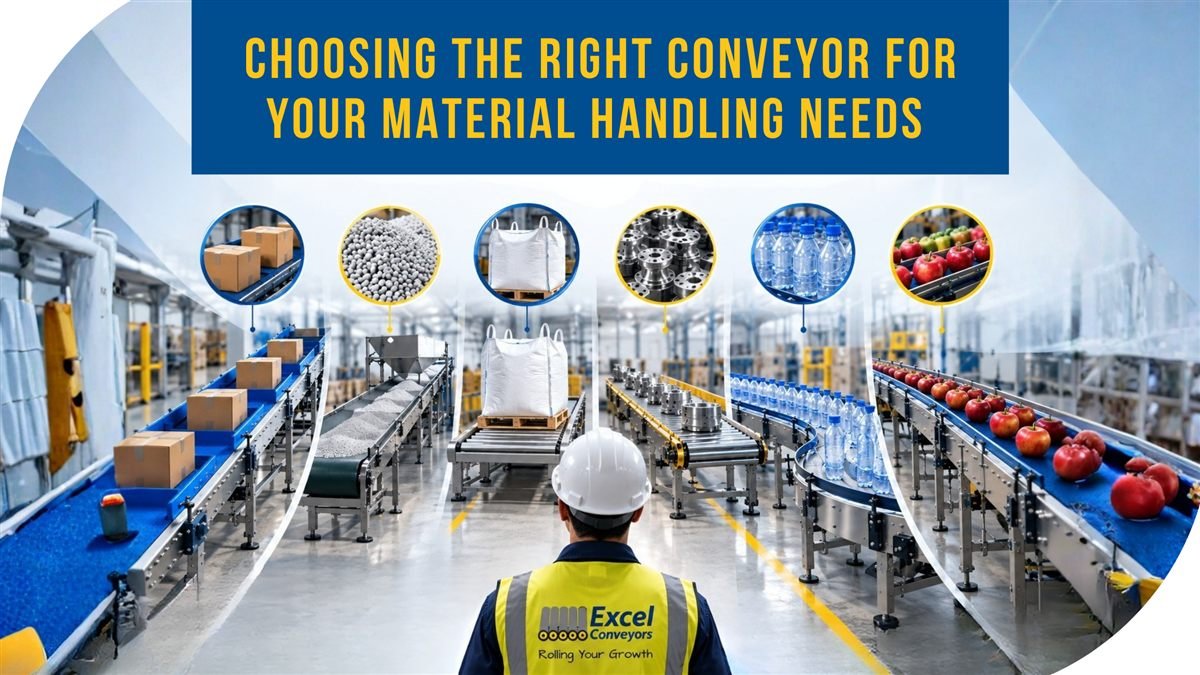
Choosing the right industrial conveyor system can have a significant impact on material handling efficiency, productivity, and operational costs. Among the most widely used options, belt conveyors and roller conveyors serve different material handling requirements.
But which one is right for your application?
The answer depends on factors such as material type, product size and weight, conveyor layout, speed, accumulation requirements, and operating environment.
In this guide, we compare belt conveyors vs roller conveyors to help you make a more informed conveyor selection.
What Is a Belt Conveyor?
A belt conveyor uses a continuous belt supported by rollers or a flat surface to transport materials from one point to another. The belt provides a stable conveying surface, making it suitable for a wide range of products and materials.
Belt conveyors are commonly used across manufacturing, warehousing, logistics, packaging, food processing, and industrial material handling applications.
Key Advantages of Belt Conveyors
- Suitable for small, irregular, or loose materials
- Provides continuous and smooth transportation
- Can handle inclined and declined conveying
- Helps prevent products from falling between conveying surfaces
- Suitable for long-distance material movement
- Available in different belt materials and configurations
- Can be integrated with automated material handling systems
Common Applications of Belt Conveyors
Belt conveyor systems are commonly used for:
- Manufacturing plants
- Packaging lines
- Warehouses
- Distribution centres
- Food processing facilities
- Bulk material handling
- Assembly lines
- Logistics operations
What Is a Roller Conveyor?
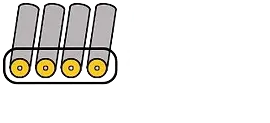
A roller conveyor consists of a series of rollers mounted within a frame. Products move over these rollers either through gravity, manual pushing, or powered rollers, depending on the conveyor design.
Roller conveyors are particularly useful for transporting boxes, cartons, pallets, containers, and other products with relatively flat and stable bases.
Key Advantages of Roller Conveyors
- Suitable for cartons, boxes, and pallets
- Allows easy movement of rigid products
- Can support accumulation in suitable configurations
- Available as gravity or powered systems
- Easy to integrate with warehouse and logistics operations
- Suitable for sorting and transfer applications
- Can handle comparatively heavy loads
Common Applications of Roller Conveyors
Roller conveyor systems are widely used in:
- Warehouses
- Distribution centres
- Packaging operations
- Shipping and dispatch areas
- Pallet handling
- E-commerce fulfilment
- Manufacturing facilities
- Material transfer lines
Belt Conveyor vs Roller Conveyor: Key Differences
Understanding the differences between these two conveyor systems can help you select the right solution for your application.
| Feature | Belt Conveyor | Roller Conveyor |
|---|---|---|
| Conveying Surface | Continuous belt | Individual rollers |
| Best For | Small, loose, irregular, and packaged materials | Boxes, cartons, pallets, and rigid products |
| Inclined Conveying | Excellent | Application-dependent |
| Product Stability | High | Depends on product base |
| Accumulation | Limited depending on design | Well-suited with appropriate design |
| Heavy Loads | Available in suitable designs | Particularly suitable |
| Product Shape | Flexible | Best for flat-bottom products |
| Applications | Manufacturing, packaging, bulk handling | Warehousing, logistics, pallet handling |
When Should You Choose a Belt Conveyor?
A belt conveyor system may be the better option when your application requires a continuous conveying surface or when the products being transported are small, irregular, loose, or difficult to move on individual rollers.
Consider a belt conveyor when:
- Your products have uneven or irregular bases
- Materials need to be conveyed at an incline
- You require continuous product support
- Materials include loose or bulk products
- Product stability is important
- You need controlled movement between different process stages
For example, belt conveyors can be useful for transporting products from one processing or packaging stage to another while maintaining consistent product movement.
When Should You Choose a Roller Conveyor?
A roller conveyor system can be a suitable choice when handling rigid products with a relatively flat base.
Consider a roller conveyor when:
- You are moving cartons or boxes
- Pallets need to be transported
- Products require accumulation
- You need a warehouse or dispatch conveyor
- Heavy and rigid products need to be transferred
- Products need to move between different workstations
Powered roller conveyors can also be incorporated into automated material handling systems where controlled movement and product transfer are required.
Factors to Consider Before Selecting a Conveyor
Selecting a conveyor should go beyond simply comparing belt conveyors and roller conveyors. Your complete application should determine the conveyor configuration.
Type and Size of Material
Consider whether you are transporting cartons, bags, pallets, components, loose materials, or other products.
Product Weight
The weight and dimensions of the product influence the conveyor's frame, belt, rollers, drive system, and overall capacity.
Conveyor Length and Layout
The available floor space and required conveying distance can influence whether you need a straight, inclined, curved, or customised conveyor configuration.
Required Speed
Your required throughput should be considered when determining the conveyor's operating speed and configuration.
Accumulation Requirements
If products need to temporarily queue or accumulate before the next process, a suitable roller conveyor system may provide advantages.
Operating Environment
Temperature, dust, moisture, hygiene requirements, and exposure to chemicals can influence the choice of conveyor materials and components.
Automation Requirements
If the conveyor will form part of an automated production or warehouse system, consider integration with sensors, controls, scanners, robotic systems, and other equipment.
Belt Conveyor vs Roller Conveyor: Which Is Better?
There is no single conveyor that is better for every application.
A belt conveyor is generally a strong choice when you need continuous product support, stable movement, inclined conveying, or transportation of irregular and loose materials.
A roller conveyor can be advantageous for rigid products such as cartons, boxes, and pallets, particularly where accumulation, transfer, or warehouse handling is required.
The right solution ultimately depends on your product characteristics, throughput, layout, operating environment, and automation requirements.
Why Choose Excel Conveyors?
At Excel Conveyors, we understand that every material handling application has different requirements. The right conveyor should be selected based on the product being handled, operational objectives, available space, and required throughput.
Our approach focuses on developing practical conveyor solutions for industrial material handling applications, helping businesses improve product movement and streamline their operations.
Whether you require a belt conveyor, roller conveyor, or a customised conveyor system, selecting the right configuration is an important step toward building an efficient material handling process.
Looking for the Right Conveyor Solution?
Choosing between a belt conveyor and roller conveyor starts with understanding your specific material handling requirements.
Get in touch with Excel Conveyors for your conveyor requirements.
For business inquiries: sales@econveyors.in
Looking for the right conveyor for your application? Get in touch with us.